eTasED™
As a novel crystallographic method, MicroED exploits the advantage that electrons interact much more strongly with material and posit considerably less damaging energy into a crystal. Electron diffraction data can be collected from extremely small nanocrystals at a low dose, which not only benefits structure research of organic compounds, but also for crystallizing problematic proteins.
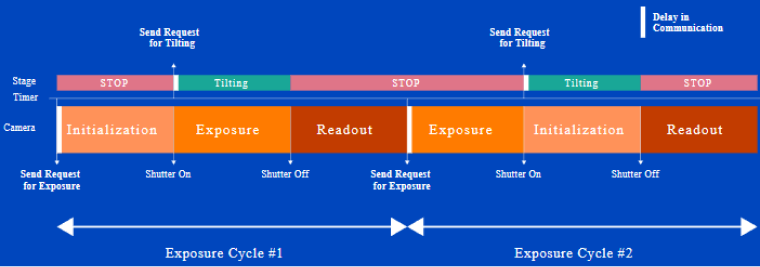
Schematic Diagram of the Stage-Camera Synchronization
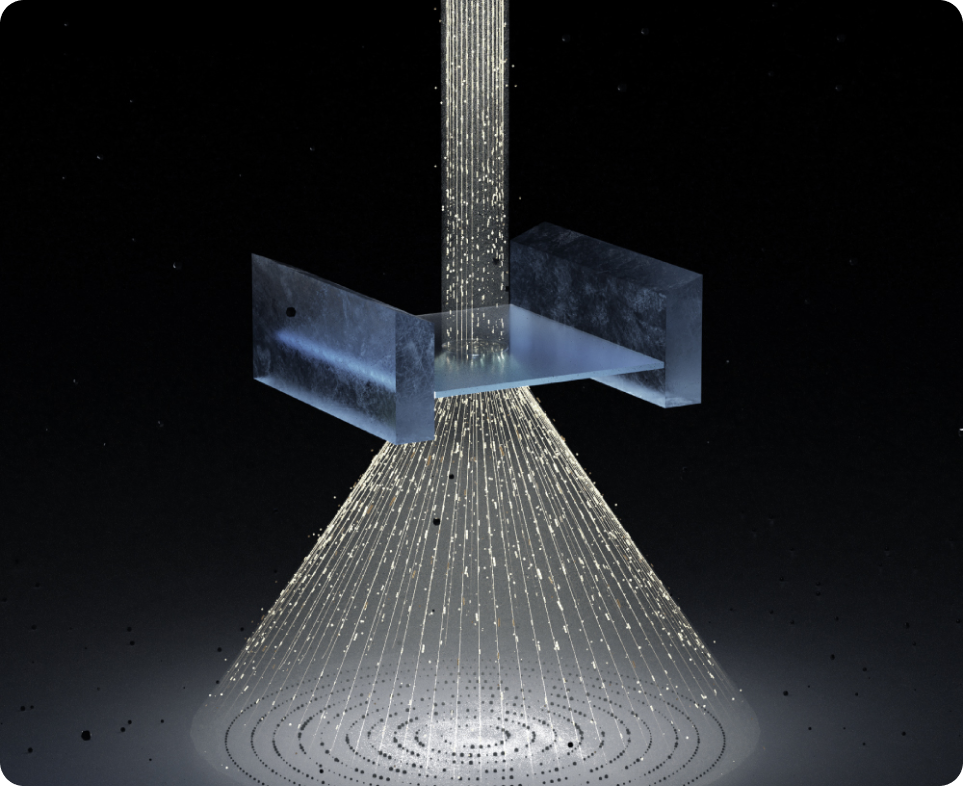
Benefiting from eTasED, MicroED can be realized on a conventional cryo-EM system without any modification
Tailored for single-frame camera
The stage tilting and sample illumination are activated and inactivated at predefined time points so that they are only activated within the effective exposure step of an exposure cycle.
Available for movie-mode camera
With a movie-mode camera, the exposure time can be set much longer than that of a single-frame camera, such that each tilting-exposure cycle covers a large or even entire range of the tilting angle.
Compatible with 120kV TEM
Ultrahigh-resolution diffraction data of peptide nanocrystals is collected on 120-kV electron microscopes, resulting in resolution up to ~0.60 Å with unambiguous assignment of nearly all hydrogen atoms.
With the application of eTasED, structures not only for small molecules but also for peptides and proteins can be realized by MicroED in SHUIMU.
MicroED Results
Proteinase K
1.50 Å, 29.05 kDa (protein)
FUS LC RAC1
0.65 Å, 0.66 kDa (peptide)
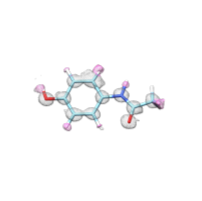
Acetaminophen
0.65 Å, 151.16 Da (small molecule)
Send us a message
Connect with Us. Make Great Things Happen Together.
To inquire about our services, simply fill out this form and we'll be in touch.